George Berkeley
Intentional or not, we tend to bottle-feed our children stories of environmental doom. In kindergarten, my classmates and I were ornamented in flower crowns and paper leaves as we waddled like ducklings onstage in our school play: “Let’s Save the Rainforest!” We banged drums and sang in unison about deforestation, a word half of us didn’t have enough teeth to pronounce. This was my introduction to environmentalism, and the message was clear: our planet is in trouble, and we have to do something to fix it!
Throughout my education, I learned more about the state of the world I was planted into. Mass extinction, climate crisis, and greenhouse gasses were some of the ‘scary words’ scraped across black boards in biology class. It seemed to me that the more I learned about the nature of the problem, the bigger it was. And the less I felt capable of fixing it. A massive shift in perspective occurred between first grade and senior year of high school. I felt the beaming optimism of my grade’s little five-year-old bards stifled into impending doom hovering across us like a thick fog. Our planet is dying, and I have no power to fix it. This central notion pinged like a time bomb strapped to my chest.
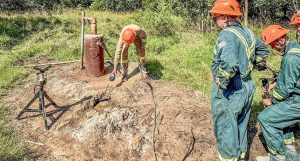
 This summer, I spent my time swatting flies and duct taping my boots to my pants to avoid ticks in the Deep Fork National Wildlife Refuge of Okmulgee, Oklahoma. I was an intern, following a colorful crew of skillful scientists and oil rig workers across forests and worksites to learn more about the environmental efforts of the Well Done Foundation, a non-profit working to resolve America’s abandoned well problem. Curtis Shuck, the chairman of the WDF, led us through a thick canopy of pecan trees and knee-high grass as we marched heavy equipment deep into the edge of the forest. The sweltering Oklahoma sky draped us in sunrays peeking between the foliage. The wind carried the sweet smell of summer. However, the environment quickly transformed as we reached the rusted oil well we’d been searching for. This particular well was a stinker, with methane emissions four times higher than what was categorized as a “super polluter”. A shallow pond just a few steps from the well is a ghoulish shade of brown, and a large hole in the concrete slab supporting the well has collected rainwater, which is bubbling like soda. That is, a soda carbonated with toxic gas.
I plug my nose as I aim a SEMTECH HI-FLOW 2, a heavy machine measuring fugitive methane particles, at the gash at the base of the well; Our well cite is encircled by a drone and videocamera as Larry Confino, the producer of PBS’s “50 States of Sustainability” asks the crew detailed questions about our data-collecting procedures. Today, we’re measuring emission levels to send to the state of Oklahoma, in hopes of receiving enough funding to properly close this well. Like many wells in the area, it’s threatening local water ways by leaking contaminated water into the ground water or nearby aquifers. This can (and will) snowball into countless issues: contaminated drinking water, damaged soil, sick wildlife, pollutants in the air. However, that doesn’t stop us from putting our boots on the ground to fix the root of the problem.
Eco-anxiety was a term I discussed at length with Larry Confino between takes for his show. A skillful director, his project led him across the country, interviewing non-profits and companies across the country proactively solving environmental problems. This week, he came to visit the Well Done Foundation to share the good work we were doing. His project was born to combat the emergence of eco-anxiety he’d noticed in young people. Nowadays, many kids are deeply concerned about their future. Although economic instability and geopolitical conflicts are high points of contention, the largest source of their fear comes from the uncertainty surrounding the longevity of our ecosystems & wildlife. Although our society has distanced itself from life in nature, and the average American doesn’t tend to spend very much time outdoors, it doesn’t change the inalienable fact that our lives are completely tied to the wellbeing of our biosphere. The food we eat, the air we breathe, the water we drink: these are resources as valuable as the veins of gold that underpin our economy.
Still, most people feel absolutely powerless in protecting our most precious resources. This is the symptom of overexposure to the heart-dropping stories of the climate catastrophe which has clogged mainstream news and social media for the better part of this century. In our click economy, shocking posts or media which propagates existential dread tends to garner more attention than feel-good stories. This is profoundly problematic: if the only stories you see about the environment are pejorative, it only perpetuates the learned helplessness many people already experience. The question then becomes: how can we fix this? We tell the whole story.
America is home to an estimated 3.5 million abandoned oil wells. Some were plugged poorly, with mud and other permeable substances which were the standard of that era, others outright neglected. Left unmanaged, these non-productive wells have leaked trace amounts of greenhouse gasses into our atmosphere for years – sometimes decades – with nobody legally required to do anything about it. The Well Done Foundation believes that the only way to fix this is by doing the dirty work: completing the life cycle of each well with precision and profound respect for the lands that we are restoring in its wake. It’s slow, sweat-soaked, gruelling work. But it is also one of the most actionable responses to an environmental crisis that is happening in the oil & gas industry. Every well plugged today can have an immediate impact which will be measurable in our own lifetime.
As we collect our samples, note our measurements, and put away our tools, the camera crew finishes up their shots. We begin to waddle, single-file through the Deep Fork, back to our trucks. We can’t help but feel a sense of purpose in our stride. Although it’s impossible to tackle the immensity of this crisis alone, every action we take tilts us in the right direction. I can’t help but feel like I’m back on that stage in elementary school, surrounded by likeminded optimists: This is a massive problem set before us, and together, we can fix it. AS we leave the Deep Fork a little cleaner than we found it, the path forward becomes clear. We might not fix the whole planet today, but we stopped a leak for the next generation, and that’ll count for something tomorrow.